










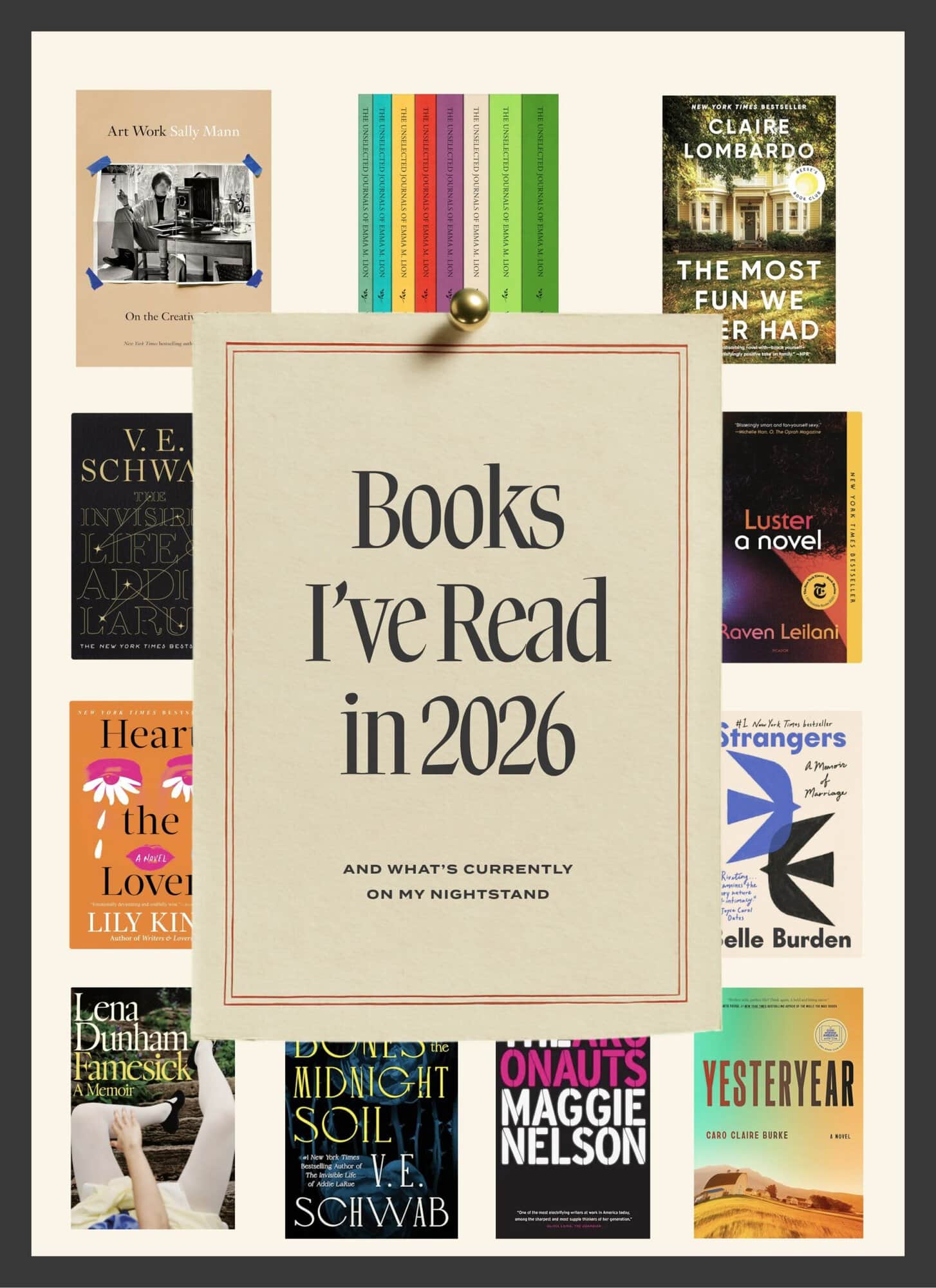
Every book I’ve loved this year has been about a woman stepping out of a performance and into something messier. Real and with consequence.
I don’t think that’s a coincidence. I’ve been doing the same thing. Quietly, awkwardly, mostly in my own head. These stories have been a permission slip. They’ve shown me what it looks like to walk away from the constructed self and into the unmapped country of who you actually are. Some of it is gorgeous. Some of it is brutal.
If you’ve been feeling the sense that the life you built is well-made but not quite yours, these are the books that have been keeping me company.
Here’s what to read, what to skip, and what’s on my nightstand.
6 Books I Loved and Recommend
Strangers by Belle Burden
Summary: A memoir of the marriage Belle Burden thought she was in, and the one she discovered she wasn’t. Early in the pandemic, her husband told her (without warning) that he was leaving. The book retraces the marriage, looking for the seams she missed, and what it asked of her to be the kind of woman who didn’t notice.
Why I Love It: Riveting, gut-wrenching, and made me think deeply about trust and intimacy. It’s also a quiet study of what compliance costs a woman over decades, what we agree not to see in order to stay.
The Unselected Journals of Emma M. Lion series by Beth Brower
Summary: Set across eight volumes, the diary-novels of Emma M. Lion follow a young woman returning to her crumbling London neighborhood of St. Crispian’s at the tail end of the 19th century, broke and entirely unbothered. There are eccentric neighbors, a feud with a cousin, an inherited house in disrepair, and very little plot in the conventional sense. You read for the company, the quiet humor, and the slow burn between Emma and three male friends who may become something more.
Why I Love It: There is so much to love about Beth’s storytelling. It’s got substance without being heavy. I am currently on my second read. Reading it again, I realize it helped me remember that a life doesn’t have to be impressive to be worth narrating.
Luster by Raven Leilani
Summary: Edie is twenty-three, broke, working a publishing job she’s about to lose, and sleeping with a married man in an open marriage. When his wife invites her into their home, and into a strange role in their family, including with their adopted Black daughter. Edie says yes. The novel follows what happens to a young woman who keeps making choices you want to save her from.
Why I Love It: The sentences. Edie is a narrator I haven’t stopped thinking about. The small internal moments when she’s lost and unable to find a way out of her predicament. Edie is funny, self-aware, and undefended in ways that made me wince… in recognition. It’s a book about wanting to be wanted, and what we’ll trade for it.
The Invisible Life of Addie LaRue by V. E. Schwab
Summary: In 1714, a young Frenchwoman makes a desperate bargain with the wrong god to escape an arranged marriage: she’ll live forever, but no one will remember her. Three hundred years of being unseen, until a young man in a New York bookshop says, “I remember you.” A love story shaped like a haunting.
Why I Love It: I picked this up not expecting to be wrecked by it. It’s a book about what it means to be known, and what it costs to insist on existing on your own terms. I think about the bargain Addie makes more often than I’d like to admit.
Heart the Lover by Lily King
Summary: A novelist looks back on a college love triangle with two best friends, and the way the choices she made then have shaped the woman she became. Decades later, a crisis brings the three of them back into contact, and she has to reckon with the version of herself she left in that house.
Why I Love It: The prose is graceful, the yearning is real. I liked it more than Writers & Lovers… the relationships at the center lean heavily on one another to earn their weight. If first-love nostalgia is your genre, you’ll feel it.
Art Work by Sally Mann
Summary: Part memoir, part field guide to making things over a long life. Sally Mann, a photographer and writer, tells the story of her own creative practice through journal entries, letters, and photographs. It echoes with plainspoken wisdom only earned by decades of doing the work. Rejection. Luck. Self-doubt. The discipline of returning to the desk or the darkroom when no one is asking you to.
Why I Love It: I needed this book and didn’t know it. It’s the most honest book about making things I’ve read in a long time. I’ve already underlined half of it.
1 Book I Think You Can Skip
The Most Fun We Ever Had by Claire Lombardo
Summary: Forty years in the life of the Sorensons, a Chicago family of two parents and four daughters who have been told all their lives that their parents’ love is the gold standard. The novel moves between decades, watching the daughters fail in their own romantic lives against the impossible benchmark, and what happens when a long-lost grandson reappears.
What I Thought: I wanted to love it. The premise is good, and the writing is beautiful. But it’s 500-plus pages of a family I never quite cared enough about, and the central conceit (everyone is measuring themselves against an enviable marriage) didn’t keep me inside the pages. If you love a sprawling family saga, you’ll eat this one up.
4 Books Currently on My Nightstand
Famesick by Lena Dunham
Summary: A memoir of the years between Girls and now. Fame, chronic illness, a body that became a project, and what it cost Dunham to be the public figure people decided she was. She traces her rise and asks the question most people don’t get to ask out loud: Was it worth it?
Yesteryear by Caro Claire Burke
Summary: The plot follows a tradwife influencer who “has it all”: eight million followers, a charming farmhouse, six photogenic children, and a cowboy husband from a famous political family. The whole thing is a production, of course. Then Natalie wakes up one morning inside the life she’s been performing: actual fire, actual filth, actual labor that bloodies her hands.
Bury Our Bones in the Midnight Soil by V. E. Schwab
Summary: Three women, three centuries, one hunger. María in 1532 Spain, trying to escape a future as a man’s prize. Charlotte in 1827 London, banished from her family’s estate after a moment of forbidden intimacy. Alice in 2019 Boston, building a new self at college until a one-night stand sends her searching for answers. The thread that runs between them is a vampire story dressed as a love story… or maybe the other way around? From the same author as The Invisible Life of Addie LaRue, which I loved, so I’m going in with high expectations.
The Argonauts by Maggie Nelson
Summary: Part memoir, part theory, part love letter. Nelson writes about falling in love with the artist Harry Dodge, becoming a mother, and watching her body and her partner’s body change at the same time. Threaded through the personal narrative is a running conversation with the thinkers who shaped her: Wittgenstein, Barthes, Eve Sedgwick, Judith Butler.
Editor’s Note: This article contains affiliate links. Wit & Delight uses affiliate links as a source of revenue to fund business operations and to be less dependent on branded content. Wit & Delight stands behind all product recommendations. Still have questions about these links or our process? Feel free to email us.

Kate is the founder of Wit & Delight. She is currently learning how to play tennis and is forever testing the boundaries of her creative muscle. Follow her on Instagram at @witanddelight_.
BY Kate Arends - April 29, 2026
Most-read posts:



Did you know W&D now has a resource library of Printable Art, Templates, Freebies, and more?
take me there
Get Our Best W&D Resources
for designing a life well-lived







Thank you for being here. For being open to enjoying life’s simple pleasures and looking inward to understand yourself, your neighbors, and your fellow humans! I’m looking forward to chatting with you.
Hi, I'm Kate. Welcome to my happy place.





Like what you see?
Share Wit & Delight with a friend: